
Oak Hill Directory Years
The official West Virginia Archives city directory list groups Oak Hill with Fayetteville and Mount Hope. The listed run is not annual. It begins in 1970 and continues through selected years to 2016, with gaps. The catalog does not state a publisher, title-page details, or whether every volume has an alphabetical, telephone, or reverse section. Those facts must be checked in the volume before quoting an entry.
| Collection | Years | Where Held | Access |
|---|---|---|---|
| Oak Hill, Fayetteville, and Mount Hope directories | 1970, 1972, 1973, 1975, 1977, 1979 | WV Archives and History | Catalog online; ask archives for volume access |
| Regional directory continuation | 1982, 1984, 1986, 1988, 1990, 1992, 1994 | WV Archives and History | Confirm format and geographic scope in each edition |
| Later listed volumes | 1996-1999, 2001, 2007-2010, 2016 | WV Archives and History | Cataloged; page images not exposed in research |
| Old directories and local collections | Years vary | Fayetteville Public Library | Ask staff for title, year, and on-site conditions |
The archive screenshot confirms the grouped place name and year list used for Oak Hill volumes.
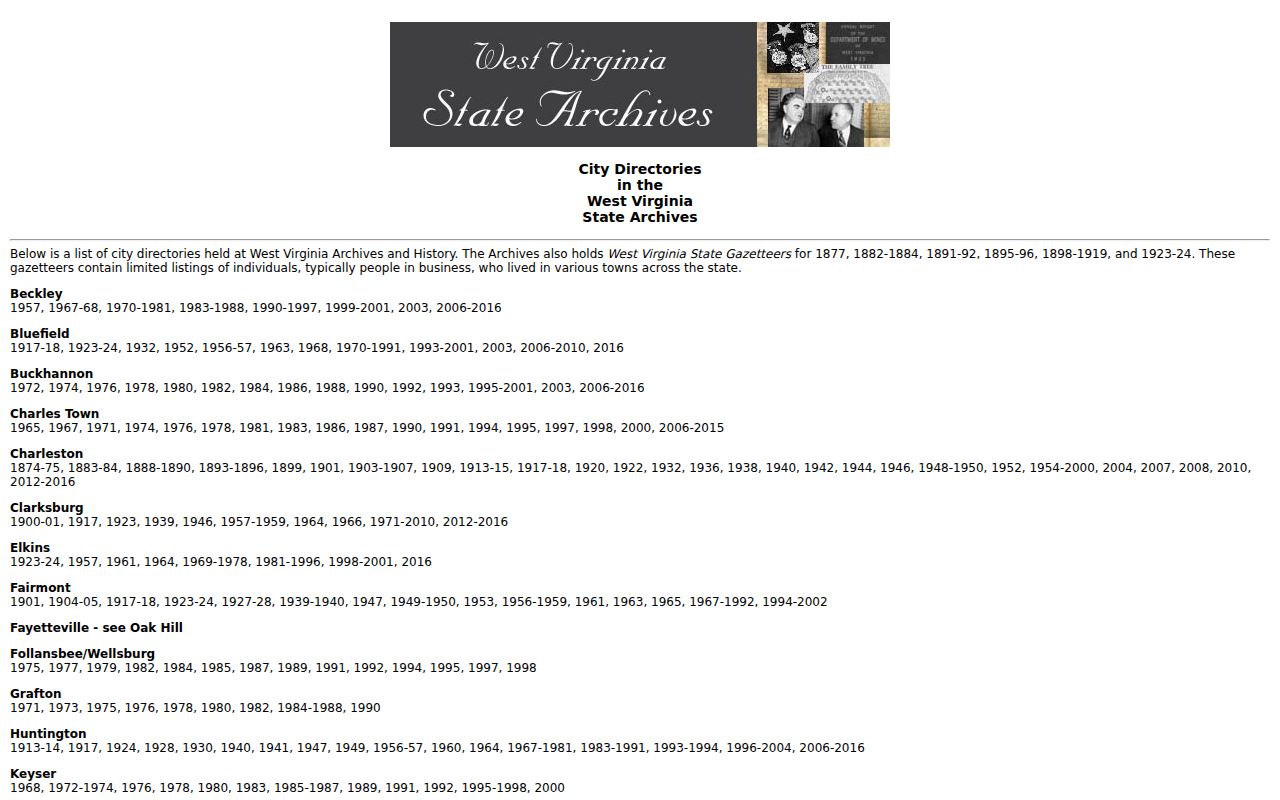
Because unlisted years may reflect a catalog or holdings gap, do not say that no directory was published without checking the repository.
Oak Hill Research at Fayetteville Library
The Fayetteville Public Library archive is the best documented local research room for county-wide Oak Hill material. Its holdings include newspaper microfilm, yearbooks, family collections, genealogy, cemetery books, old directories, photos, scrapbooks, and a West Virginia collection. Ask for an exact title and year before traveling. The page lists categories, but it does not promise that every item is digitized or available without staff help.
The library capture shows the archive tabs that lead beyond a simple surname search.
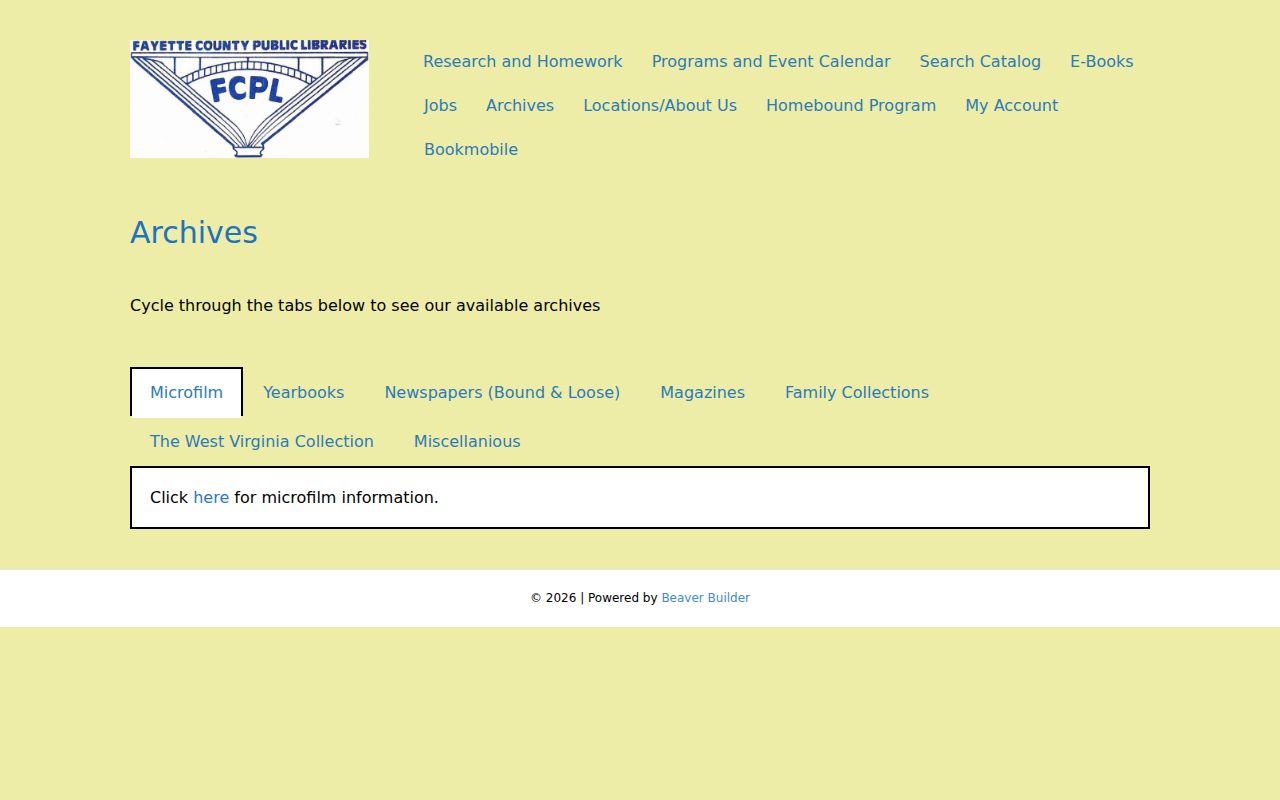
Old Oak Hill Garden Club scrapbooks, Sports Festival photo books, cemetery books, and family collections can place a name in community life when no directory page is available.
Oak Hill Public Library at 611 Main Street is part of the same seven-branch county system. Its official profile lists 304-469-9890 and notes that the branch opened in 1968. Call either branch to learn which building holds the needed volume, reel, or local collection.
Oak Hill Directory Timeline
A short timeline keeps the printed volumes beside the sources that can fill their gaps. It also prevents a later directory address from being projected backward into a much older Oak Hill record.
| Period | Available research layer |
|---|---|
| 1877-1924 | State gazetteers in selected years, with limited business and people coverage |
| 1926 | First identified digitized Oak Hill Sanborn map set |
| 1942 | Second identified Sanborn set, useful beside wartime newspapers and the 1950 census |
| 1970-2016 | Selected grouped Oak Hill, Fayetteville, and Mount Hope directory volumes |
Gazetteers are not complete resident directories. Their coverage often emphasizes businesses, professions, or town descriptions. Label the source type exactly, and record the printed year from the title page.
For years before the printed directory run, a gazetteer can still identify a trade, post office, firm, or town spelling. Pair that clue with the matching census district, Fayette deed or probate volume, and newspaper date. The cross-check matters because a gazetteer entry may describe a commercial place rather than the person's home. Ask the archives for the exact volume and page instead of citing only the online holdings list.
Read Oak Hill Directory Entries
No sample Oak Hill directory page was retained in the research. Do not invent local abbreviations, a publisher, or a named resident. Inspect the edition's title page and key first, then transcribe only the fields actually printed. A careful inventory separates printed facts from common directory conventions that still need confirmation.
| Printed name | Copy spelling, initials, and order exactly as shown. |
|---|---|
| Household notation | Record a spouse or widow reference only if the edition prints one. |
| Street address | Preserve number, direction, street name, and any unit or community wording. |
| Work or business field | Transcribe the printed role and business address without treating it as a home address. |
| Symbols and abbreviations | Decode them from that volume's key, not from a different publisher. |
- Criss-cross directory
- A section arranged by street and number, useful for reading one block in order.
- Householder index
- A list centered on the person named for a household, with coverage that varies by edition.
- Abbreviation key
- The edition's own guide to shortened words and symbols; save it before interpreting an entry.
A printed entry is evidence for the publication period. It may lag a move, omit an unlisted household, or group communities in a way that does not match current limits. Cite the title, year, page, and repository with the transcription.
Check the title page for geographic scope before treating the place heading as a city limit. The archive groups Oak Hill with Fayetteville and Mount Hope, so one volume may arrange those communities in separate parts or in one regional sequence. Note the section heading with the entry. If the directory includes a street index, compare the alphabetical listing with the address listing. A disagreement may be a print error, a move during compilation, or an abbreviation read the wrong way. Preserve both entries until a dated record settles the issue.
Telephone and business entries need the same care. A number may belong to a business, shared line, or household at the time of publication. An occupation or firm address is not a home address. Use it as a lead for a newspaper, business filing, or city license record, then keep each role separate in the research notes.
Map Old Oak Hill Addresses
The WVU Regional History Center Oak Hill Sanborn collection identifies digitized 1926 and 1942 map sets. The record describes 11 TIFF files totaling about 2.09 GB. These fire-insurance maps can supply a street intersection, building footprint, construction note, or nearby rail feature. They provide place evidence, not a personal roster.
The WVU collection record captured for Oak Hill shows the digitized object and repository request route.
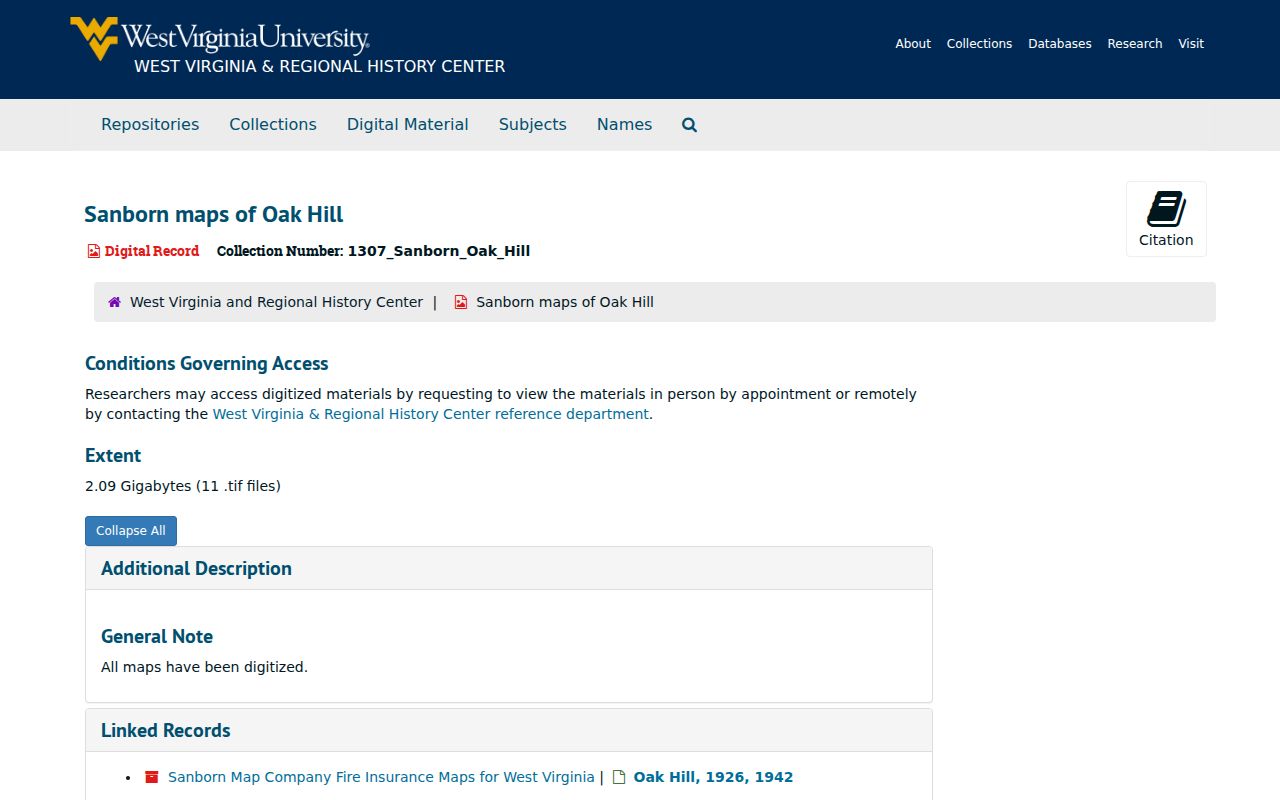
Record the sheet number and map date before pairing a building with a directory, deed, census, or newspaper item.
The 1926 maps fit the surviving Fayette Tribune runs from the 1920s. The 1942 maps can be read beside wartime newspapers and the 1950 census. A building label does not show who lived there, and a current parcel outline should not be forced onto the older footprint.
Fill Oak Hill Directory Gaps
The 1950 Census search for Fayette County identifies Oak Hill enumeration areas northeast, southwest, and southeast of West Summerlee. Handwritten names may be misread by optical character recognition, so inspect the image and enumeration description. The 1930 Census finding aids help locate the right district and reel before searching a street.
Newspapers add dated events and relationships. Fayetteville Public Library lists Fayette Tribune runs beginning with 1907-1908, later groups in the 1910s through 1930s, 1963-1967, and 1968 forward. Verify the exact reel before requesting an obituary, marriage item, school notice, church report, club event, or property notice. Save the publication, issue date, page, and column.
Note: A census household, obituary relationship, or newspaper address is historical evidence and should never be presented as a current household.
Harlem Heights in Oak Hill Records
The National Park Service history of Harlem Heights documents Lincoln, High, and Lewis streets, HomeSeekers Land and Building lots, a school operating from 1947 to 1967, churches, civic groups, and a historic voting precinct. These details give names in a city directory a real community setting. They must remain historical. The NPS account is not a list of current residents.
Harlem Heights also shows why a regional Oak Hill volume may need more than an alphabetical search. Browse the street section if present, then test the same place in the map, census district, newspaper, and parcel sources. A church, school, or civic role can distinguish two similar names without relying on private identifiers.
Trace Family in Oak Hill Directories
Family research works best as a dated chain, not a collection of same-name hits. Begin with a known year, then move one listed edition at a time. The gaps between Oak Hill city directories are normal, so use a census, newspaper, cemetery book, deed, or vital index as the bridge.
- Choose the closest listed directory year and record the full title, repository, page, and printed place heading.
- Copy the name and address exactly. Photograph or transcribe the abbreviation key before expanding any shortened terms.
- Move to the next available volume and log each change, including a spelling shift, disappearance, or new street number.
- Pair 1920s or 1940s place evidence with the matching Sanborn set, and pair census decades with the correct enumeration district.
- Use newspaper reels, cemetery books, vital indexes, deeds, or probate records to test why the trail changed.
Disappearance does not prove death or departure. The person may be outside that volume's geographic scope, unlisted, spelled differently, living in another household, or absent because the archive lacks the year. Confirm the reason with another dated source. For a modern parcel and owner trail, continue with the Oak Hill street directory rather than extending an old entry into the present.